



Rabies
It is the mission of the Bureau of Epidemiology to prevent and control the transmission of rabies to residents and visitors of Delaware.
For Providers
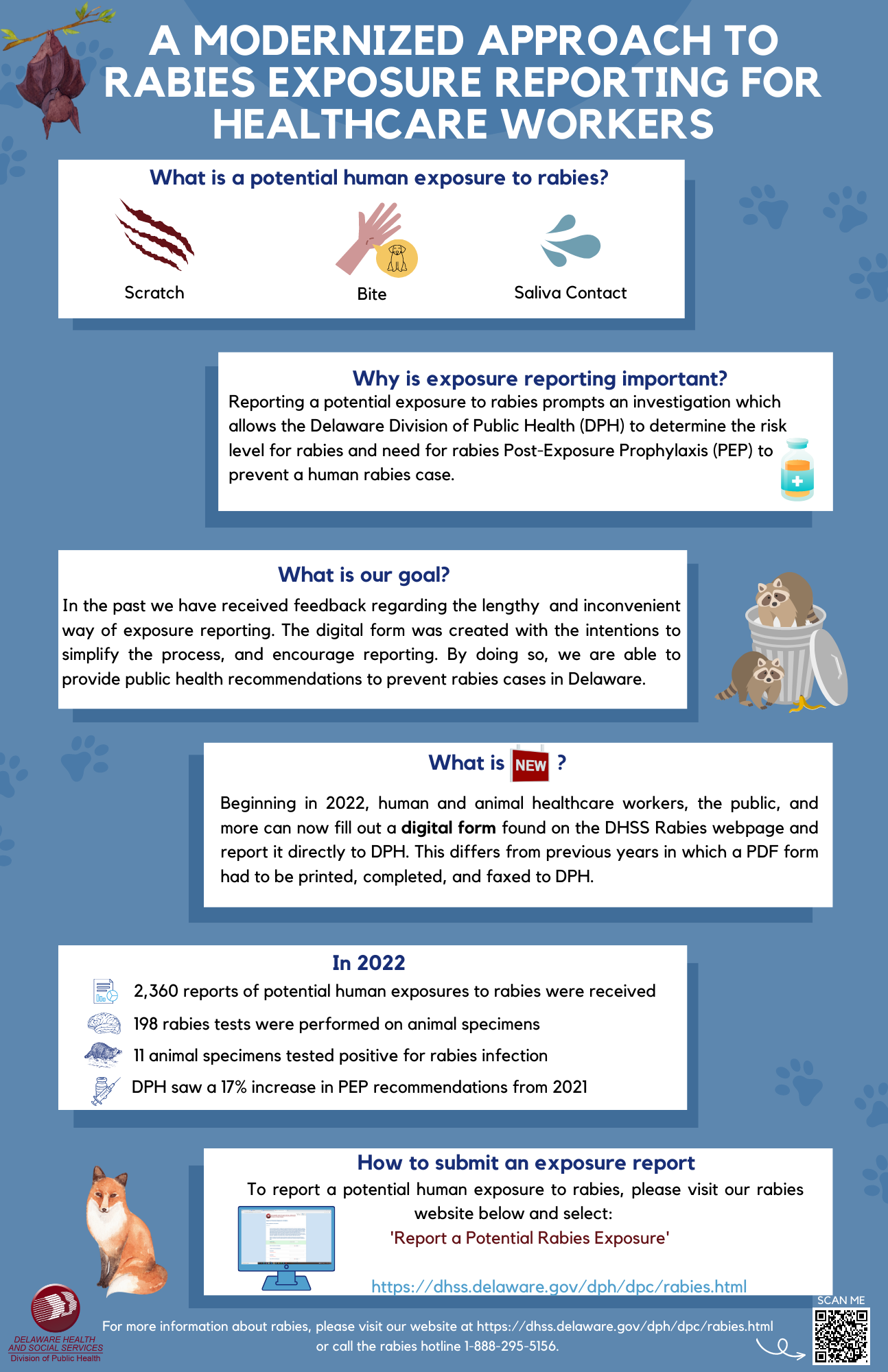
The Delaware Division of Public Health (DPH) will be collecting data on potential human exposures to rabies in a REDcap survey effective Jan. 1, 2022. This will eliminate the need to complete and fax the exposure report to DPH. REDCap is a secure web application for building and managing online surveys and databases. To report a potential exposure to rabies, please select ‘Report a Potential Rabies Exposure’ below.
Report a Potential Rabies Exposure
Rabies exposures are defined as situations where the saliva or brain/nervous system tissue of a potentially infectious animal is introduced into a bite wound, open cuts in skin (scratches from nail OR tooth), or onto mucous membranes such as the mouth or eyes. All exposures, regardless of vaccination status, should be reported to DPH in a timely manner. If you experience any technical difficulties completing the online survey, complete the PDF below and fax to 302-622-4149.
Potential Human Exposure to Rabies PDF
Exposure Reporting Infographic
General Public Information
- Office of Infectious Disease Epidemiology Location
- Contact us!
- Animal Bite Report – Department of Agriculture–Offending Animal Report
- Human Rabies Post-Exposure Prophylaxis (PEP) Protocol
- Veterinary Management of Domestic Animals that Potentially Expose Humans to Rabies
- Rabies Exposure – You’ve been bitten by an animal. What now?
What is Rabies?
- Rabies is a preventable viral disease usually caused by the bite of an infected mammal.
- The virus infects central nervous system and ultimately results in death.
What animals can get rabies?
- Only mammals carry rabies.
- Most common among wild animals such as raccoons, bats, skunks and foxes.
- Pets and livestock can get rabies if they are not vaccinated to prevent infection.
- The most common carrier of rabies in Delaware is the raccoon.
- Among domestic animals, feral cats are most frequently diagnosed with rabies in Delaware.
Delaware Rabies Statistics and Data
Delaware – Confirmed Rabies Cases by Species
| Species | 2013 | 2014 | 2015 | 2016 | 2017 | 2018 | 2019 | 2020 | 2021 | 2022 | 2023 |
| Raccoon | 8 | 2 | 2 | 2 | 4 | 6 | 6 | 1 | 4 | 2 | 0 |
| Fox | 4 | 3 | 3 | 0 | 1 | 5 | 0 | 0 | 1 | 3 | 0 |
| Bat | 3 | 1 | 2 | 1 | 2 | 0 | 0 | 1 | 6 | 1 | 2 |
| Cat | 1 | 3 | 3 | 2 | 6 | 5 | 2 | 4 | 3 | 4 | 2 |
| Skunk | 0 | 0 | 0 | 0 | 0 | 0 | 1 | 0 | 2 | 1 | 1 |
| Dog | 0 | 0 | 0 | 0 | 1 | 1 | 0 | 0 | 1 | 0 | 0 |
| Groundhog | 1 | 0 | 0 | 0 | 0 | 0 | 0 | 0 | 0 | 0 | 1 |
| Sheep | 0 | 0 | 0 | 0 | 0 | 0 | 0 | 0 | 0 | 0 | 0 |
| Horse | 0 | 0 | 0 | 1 | 0 | 1 | 0 | 0 | 0 | 0 | 0 |
| Donkey | 0 | 0 | 0 | 0 | 0 | 1 | 0 | 0 | 0 | 0 | 0 |
| Cow | 0 | 0 | 0 | 0 | 0 | 0 | 0 | 0 | 1 | 0 | 1 |
| Deer | 0 | 0 | 0 | 0 | 0 | 0 | 0 | 0 | 1 | 0 | 0 |
| Total | 17 | 9 | 10 | 6 | 14 | 19 | 9 | 6 | 19 | 11 | 7 |
Delaware – Rabies Tests Performed
| Year | Statewide Total | New Castle County | Kent County | Sussex County | Out of State | Unknown |
|---|---|---|---|---|---|---|
| 2013 | 143 | 55 | 37 | 50 | 1 | 0 |
| 2014 | 140 | 52 | 44 | 36 | 8 | 0 |
| 2015 | 113 | 45 | 31 | 32 | 5 | 0 |
| 2016 | 131 | 62 | 31 | 26 | 12 | 0 |
| 2017 | 136 | 77 | 28 | 24 | 7 | 0 |
| 2018 | 144 | 70 | 29 | 41 | 4 | 0 |
| 2019 | 157 | 88 | 30 | 33 | 6 | 0 |
| 2020 | 121 | 58 | 18 | 39 | 6 | 0 |
| 2021 | 193 | 95 | 38 | 44 | 16 | 0 |
| 2022 | 198 | 97 | 43 | 41 | 17 | 0 |
| 2023 | 192 | 94 | 49 | 41 | 8 | 0 |
Delaware – Total Reports of Potential Human Exposure to Rabies*†
| Year | Statewide Total | New Castle County | Kent County | Sussex County | Unknown County | Out of State |
|---|---|---|---|---|---|---|
| 2013 | 2001 | 1012 | 470 | 519 | 7 | 198 |
| 2014 | 2135 | 1131 | 486 | 518 | 0 | 208 |
| 2015 | 2004 | 1088 | 423 | 493 | 0 | 199 |
| 2016 | 2016 | 1063 | 425 | 528 | 3 | 231 |
| 2017 | 1727 | 880 | 329 | 518 | 1 | 151 |
| 2018 | 2198 | 1105 | 418 | 675 | 13 | 263 |
| 2019 | 2346 | 1233 | 375 | 738 | 6 | 278 |
| 2020 | 2020 | 1056 | 360 | 604 | 3 | 253 |
| 2021 | 2336 | 1218 | 300 | 539 | 10 | 169 |
| 2022 | 2360 | 1084 | 358 | 548 | 146 | 224 |
| 2023 | 2639 | 1151 | 402 | 757 | 89 | 240 |
*Potential human exposures to rabies are defined as situations where the saliva or brain/nervous system tissue of a potentially infectious animal is introduced into a bite wound, open cuts in skin (scratches from nail or tooth), or onto mucous membranes such as the mouth or eyes.
†Based off reported victim demographics
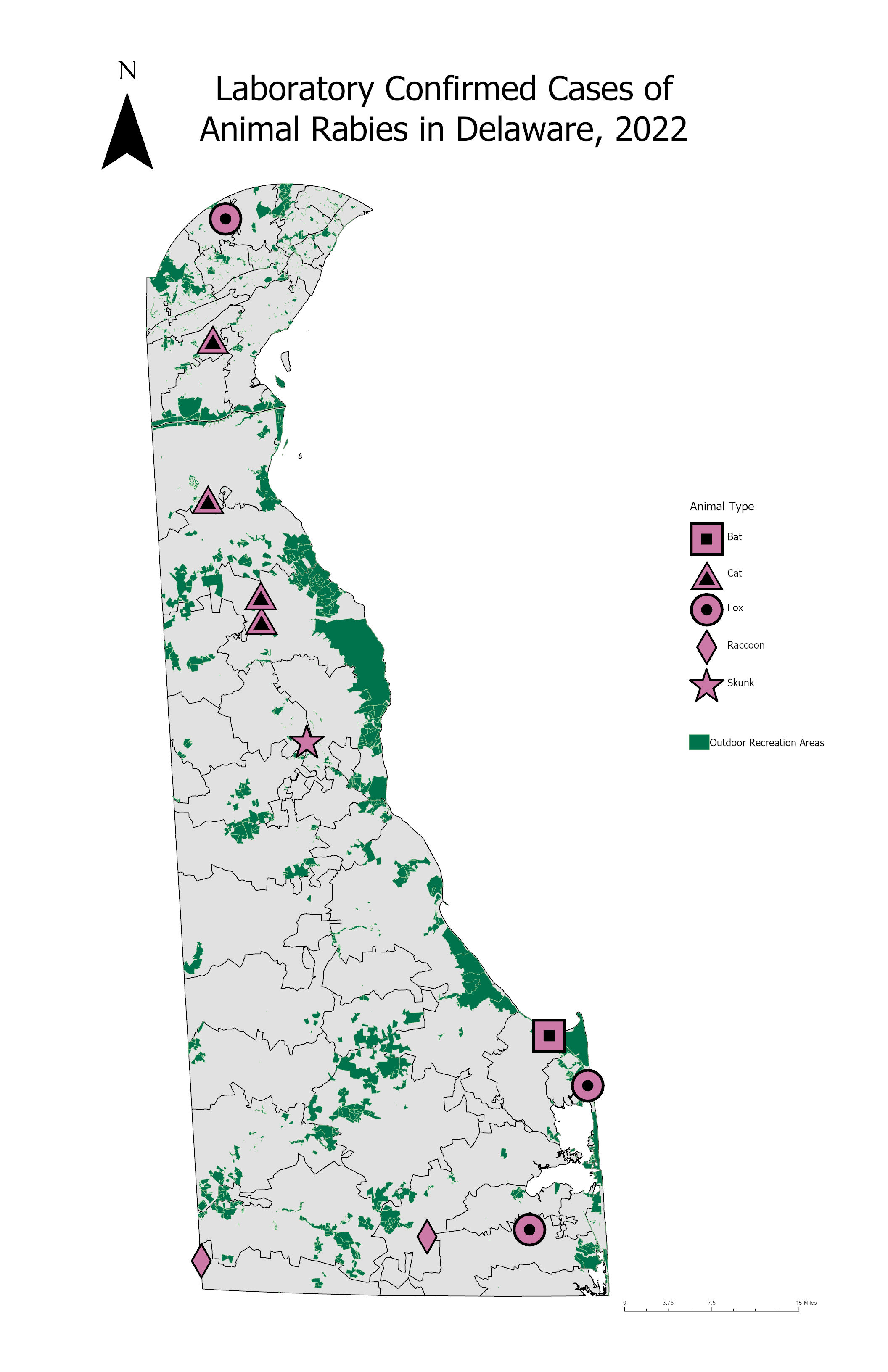
-Specimens confirmed to be infected with rabies by the Delaware Public Health laboratory using direct fluorescent antibody (DFA) testing in 2023.
How is rabies spread to humans?
- After being bitten or scratched by an infected animal.
- Less common routes of exposure include contamination of mucous membranes (i.e., eyes, nose, mouth) and aerosol transmission.
- Contact with the blood, urine or feces of a rabid animal, are not associated with risk for infection and are not considered to be exposures of concern for rabies.
- Petting an animal infected with the rabies virus is not associated with risk for infection and are not considered to be exposures of concern for rabies.
What should I do if I am potentially exposed to rabies?
- Wash all wounds thoroughly with soap and water and seek medical attention immediately even if the wound seems minor.
- All medical providers are required to report potential human exposure to the Delaware Division of Public Health by contacting the Rabies Hotline or by completing the human exposure report.
- Healthy dogs, cats and ferrets that have bitten or potentially exposed a human can be quarantined and observed for 10 days following the exposure. If the animal remains healthy during this period, it did not transmit rabies at the time of the bite.
- Management of animals other than dogs, cats and ferrets depends on many factors such as species, circumstances of the bite, the biting animal’s history, and the animal’s potential for exposure to rabies. These situations are managed on a case-by-case basis.
- If an animal cannot be observed or tested for rabies, as is common with many types of wildlife, treatment may be necessary for the people exposed. The Office of Infectious Disease Epidemiology will assist you and your physician to make that determination.

What is the treatment for people exposed to rabies?
According to the Advisory Committee on Immunization Practices (ACIP), treatment after rabies exposure consists of:
- A single dose of human rabies immune globulin (HRIG), plus 4 doses of rabies vaccine given over a two week period on days 3, 7, and 14 following the initial injection. (Individuals with weakened immune systems may require a 5th dose of vaccine).
- A person who has already been vaccinated for rabies and is exposed again must receive two booster doses of vaccine, three days apart. These individuals do not need the HRIG injection.
What can people do to protect themselves against rabies?
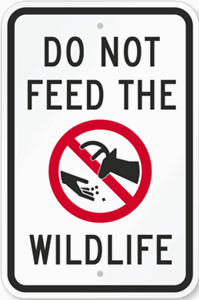
- Do not feed, touch or adopt wild animals, stray dogs or cats.
- Teach children not to touch any animal they do not know and to tell an adult immediately if they are bitten by any animal.
- Be sure your pet dogs, cats and ferrets are properly immunized against rabies.
- Keep family pets indoors at night. Never leave a pet outside unattended or let them roam free.
- Do not attract wild animals to your home or yard. Keep your property free of bird seed or other foods that may attract wild animals.
- Feed pets indoors.
- Tightly cap or put away garbage cans.
- Board up any openings to your attic, basement, porch or garage and cap your chimney with screens.
- If a wild animal is on your property, let it wander away. Bring children and pets indoors and alert neighbors who are outside. You may contact a nuisance wildlife control expert who will remove the animal for a fee. These professionals can be found in your telephone directory under pest control.
- To report a sick or hurt wild animal, Delaware residents are asked to contact the DNREC’s Wildlife Section at 302-739-9912 or 302-735-3600. Staff will determine whether it is more appropriate to refer callers to a permitted volunteer wildlife rehabilitator.
- Bats can be very difficult to keep out of homes and other buildings because they can enter through very small cracks. “Batproofing” should be done during the fall and winter months. Pest control experts can provide these services for a fee.
How do I protect my pet from rabies?
- Vaccinate pets and keep their shots up-to-date.
- If your pet is injured by another animal or presents with an unknown wound after being outdoors contact your veterinarian for medical care. Your pet may need to be quarantined for a short period of time to assure they were not exposed to a rabid animal.
- For any questions regarding an animal quarantine, please contact the Delaware Department of Agriculture (DDA) at 302-698-4630.
- Division of Public Health (DPH), Office of Animal Welfare (OAW) will visit the home of any person that has been bitten, scratched, or experienced contact with saliva or brain/ neural tissues of a potentially rabid animal. This service is provided throughout the state of Delaware. OAW can be contacted at 302-255-4646. You can also e-mail the OAW at: delawareanimalservices@delaware.gov
Frequently Asked Questions:
-
There is a wild animal (fox, raccoon, skunk, etc.) on my property/in my neighborhood and it is appearing unwell. What should I do?
- The Division of Public Health (DPH) cannot test any animal for Rabies unless there was a potential human exposure. Please contact the Office of Infectious Disease Epidemiology at 888-295-5156 to determine whether there is an exposure that meets the criteria for testing. If the animal does not meet the criteria for testing, DPH recommends avoiding contact with the animal, and contacting a nuisance wildlife control expert who will remove the animal for a fee. These professionals can be found in your telephone directory under pest control. The Division of Public Health is not responsible for removal, relocation, or rehabilitation of any wildlife. Please contact the DNREC’s Wildlife Section at 302-739-9912 to determine whether a sick or hurt wild animal may require rehabilitation.
-
My pet/ livestock (dog, cat, horse etc.) was involved in an incident where it had been exposed (bit, scratched, etc.) to another animal (such as a raccoon, dog, etc.). What should I do?
- If a pet is suspected to have been bitten by another animal, DPH recommends calling a private veterinarian or the Delaware Department of Agriculture at 302-698-4500. The Division of Public Health cannot test any animal for Rabies unless there was a potential human exposure. Please contact the Office of Infectious Disease Epidemiology at 888-295-5156 to determine whether there is a human exposure that meets the criteria for testing.
-
I discovered a bat in my home. What should I do?
- When dealing with bats, individuals may not be aware of how long the bat had been in their home and whether it could have exposed them, especially while they were asleep, unconscious, or incapacitated. If any uncertainty, please contact the Office of Infectious Disease Epidemiology at 888-295-5156 to determine whether there is a potential exposure that meets the criteria for testing or post exposure prophylaxis (PEP). If it meets the criteria, an officer from the Office of Animal Welfare will retrieve the bat from your home to be tested for Rabies.
-
I got bit feeding a squirrel. What should I do?
- Small rodents (like squirrels, hamsters, guinea pigs, gerbils, chipmunks, rats, and mice) and lagomorphs (including rabbits and hares) are almost never found to be infected with rabies and have not been known to transmit rabies to humans. In all cases involving rodents, the Division of Public Health should be consulted before a decision is made to initiate postexposure prophylaxis.
Links to Current Rabies Media Releases:
-
RABIES EXPOSURE RISK INCREASES AS COMMUNITY CATS AND WILDLIFE SPECIES KNOWN TO TRANSMIT THE VIRUS BECOME MORE ACTIVE OUTDOORS
-
FOX IN FRANKFORD TESTS POSITIVE FOR RABIES; RESIDENTS ADVISED OF ATTACKS ON STRAY CATS
- FOX IN REHOBOTH BEACH TESTS POSITIVE FOR RABIES
Partner Links:
- Reporting Sick or Dead Wildlife (Department of Natural Resources and Environmental Control)
- Division of Fish and Wildlife (Department of Natural Resources and Environmental Control)
- Rabies (Department of Agriculture)
- Rabies Exposure (Delaware Animal Services)
- Rabies Virus (Delaware Public Health Laboratory)
More Information About Rabies:
- Rabies FAQ Fact Sheet
- Rabies Virus Slides
- Centers for Disease Control and Prevention (CDC), Rabies
- World Health Organization (WHO) Frequently Asked Questions (FAQ’s) on Rabies
- CDC, Rabies and Kids
-
Never Touch a Bat – CHILDREN (English) (Espanol) (Portugues)
- American Veterinary Medical Association Rabies Brochure – in English | en Español
- Compendium of Animal Rabies Prevention and Control, 2008 –
- ACIP Recommendations: Use of a Reduced (4-Dose) Vaccine Schedule for Postexposure Prophylaxis to Prevent Human Rabies (MMWR, March 19, 2010)
- Delaware Code (Title 3, Chapter 82, Subchapter I) – Rabies Control in Animal and Human Populations
Office of Infectious Disease Epidemiology
24/7 Emergency Contact Number: 1-888-295-5156
Return to Infectious Disease Home Page
 Please note: Some of the files available on this page are in Adobe PDF format which requires Adobe Acrobat Reader. A free copy of Adobe Acrobat Reader can be downloaded directly from Adobe . If you are using an assistive technology unable to read Adobe PDF, please either view the corresponding text only version (if available) or visit Adobe’s Accessibility Tools page.